LatestBest Practices for Identifying and Securing Non-Human Identities
Resource / Online Journal
Why Passwords Fail and Biometrics Prevail in Cybersecurity?
Read the article to enhance your digital security with biometrics and understand how they are better than passwords.
Published on Apr 2, 2026

Enterprise identity teams are under siege from credential stuffing attacks, where stolen passwords from data breaches are tested at a massive scale against corporate systems. With employees often reusing credentials across personal and work accounts, a single breach can lead to widespread account compromises, exposing sensitive data and disrupting operations.
Executive Summary
Passwords underpin most authentication systems, yet they falter in regulated industries due to reuse, sharing, and weak enforcement, contributing to over 80% of security breaches. Biometrics, leveraging unique physical and behavioral traits, emerge as a compelling alternative, enabling stronger identity verification while addressing modern cybersecurity threats like automated attacks.
The Password Problem: Credential Stuffing and Reuse Risks
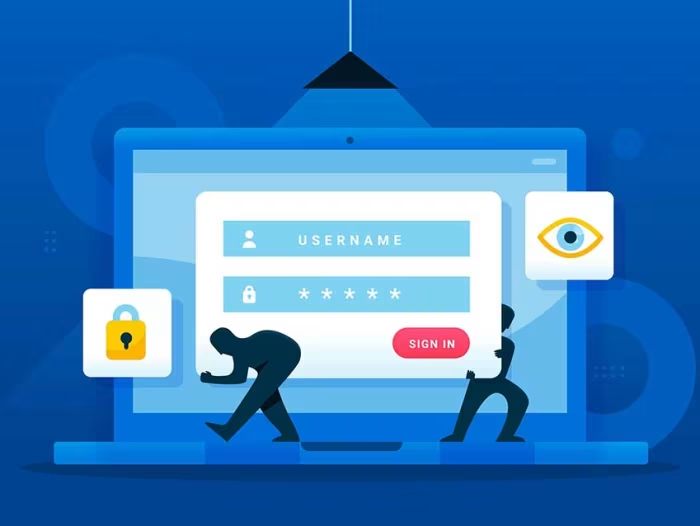
Credential stuffing works like this: attackers harvest username-password pairs from the dark web, often from retail or gaming site breaches. They then deploy bots to hammer enterprise login pages, rotating IPs and mimicking human delays to bypass rate limits. Success rates climb because people reuse passwords, studies show averages of 13 sites per credential, turning a minor personal breach into enterprise chaos, like lateral movement or ransomware entry points.
Impacts are stark: billions of attempts yearly fuel multimillion-dollar breaches, with regulated sectors facing fines under GDPR or NIST frameworks for failing access controls. Compliance gaps widen as static passwords can't adapt to evolving security threats, leaving digital assets vulnerable.
What Is Biometric Authentication?
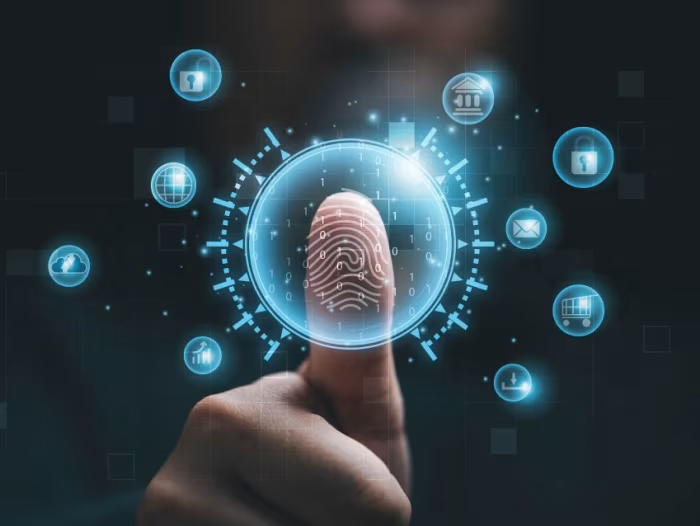
Biometrics verify identity through inherent traits, either physiological (fingerprints, iris patterns, facial features) or behavioral (typing speed, mouse movements). Enterprise systems favor these for their "something you are" factor, reducing reliance on memorable secrets.
Facial recognition shines in customer identity and access management (CIAM) for seamless portals and privileged access management (PAM) for admins. Behavioral biometrics, meanwhile, runs quietly in the background, continuously checking for deviations without user prompts.
How Biometric Systems Function
The process starts with enrollment: a user scans their trait (example- a face) multiple times. Software extracts a mathematical template, a hashed, irreversible representation, not the raw image. During login, a fresh scan generates a new template for comparison; matches and grant access in milliseconds.
On-device storage keeps templates local via encryption (like AES-256), minimizing central server risks versus cloud storage. Liveness detection weaves in passive checks for natural micro-movements like blinks, or active ones prompting head turns, to foil static spoofs.
Biometric Vulnerabilities: Real Threats
Biometrics aren't invincible in their entirety. Presentation attacks use photos, masks, or 3D prints to trick sensors. Deepfakes, powered by AI, generate hyper-real videos, with incidents surging as tech democratizes synthetic media. Stolen templates pose reconstruction risks if weakly protected, potentially enabling unauthorized access.
Effective Mitigations
Counter with multilayered defenses: passive liveness analyzes texture and reflections; on-device encryption ensures templates stay useless offline. Multimodal biometrics, face plus voice or gait, dramatically cuts false matches, balancing security and usability.
Integrating with Cloud, Endpoint, and Identity Security
Cloud environments split responsibilities: providers secure infrastructure, but identity and endpoint security fall to users. Biometric sensors on mobiles or IoT devices demand hardened firmware against tampering. Map controls to critical infrastructure via NIST guidelines, emphasizing secure enrollment and template lifecycle (update, revoke).
Biometrics in Multi-Factor Authentication for High Stakes
Position biometrics as a robust MFA factor for critical systems, like industrial controls. Step-up authentication triggers it for privileged sessions, paired with PAM to enforce least privilege. These layers defenses, thwarting identity theft even if one factor slips.
The Power of Behavioral Biometrics
Behavioral biometrics excels for session continuity, monitoring traits like keystroke dynamics or swipe patterns. Anomalies, sudden typing slowdowns, flag takeovers via machine learning thresholds. Privacy-friendly designs aggregate anonymized data, avoiding PII storage and complying with consent rules.
Practical Implementation Roadmap
Mid-sized firms should pilot on low-risk apps, like internal tools, before folding into MFA flows. Gradually migrate legacy identity management (IDM) to identity governance and administration (IGA), phasing out passwords. Scale via partnerships for ops, testing false rates early.
Privacy, Compliance, and Data Handling
Minimize biometric data to essentials, secure consent at enrollment. Regional laws like GDPR treat biometrics as sensitive, mandating encryption and breach notifications. Data minimization, storing only templates, curbs exposure.
Competitive Landscape and Services
Providers offer accelerators for CIAM/IGA pilots, blending biometrics with Zero-Trust. Advisory steps include gap assessments, vendor selection, and integration playbooks, essential for multi-cloud setups. Start with TechDemocracy's managed pilots using accelerators for CIAM and IGA integration.
Conclusion: Building Resilient Authentication
Passwords crumble under industrialized threats, credential stuffing, phishing, reuse, failing modern landscapes where attackers weaponize scale. Biometrics, woven into layered strategies like MFA, zero-trust and continuous monitoring, deliver resilient identity security without the friction.
Enterprises adopting them with us can outpace breaches, safeguarding critical infrastructure and digital identities in an era of relentless cybersecurity evolution. Start small, measure rigorously, and evolve toward passwordless futures.
Recommended articles
Passwordless Authentication: Are We Asking the Right Questions?
Take Your Identity Strategy
to the Next Level
Strengthen your organization's digital identity for a secure and worry-free tomorrow. Kickstart the journey with a complimentary consultation to explore personalized solutions.