LatestBest Practices for Identifying and Securing Non-Human Identities
Resource / Online Journal
Passwordless Authentication: Hype or the Future of Security?
Passwordless Authentication eliminates shared secrets and reduces phishing risk through FIDO2 authentication and phishing-resistant authentication methods. As organizations adopt Zero Trust security, passwordless is quickly becoming the future of secure access.
Published on Feb 20, 2026
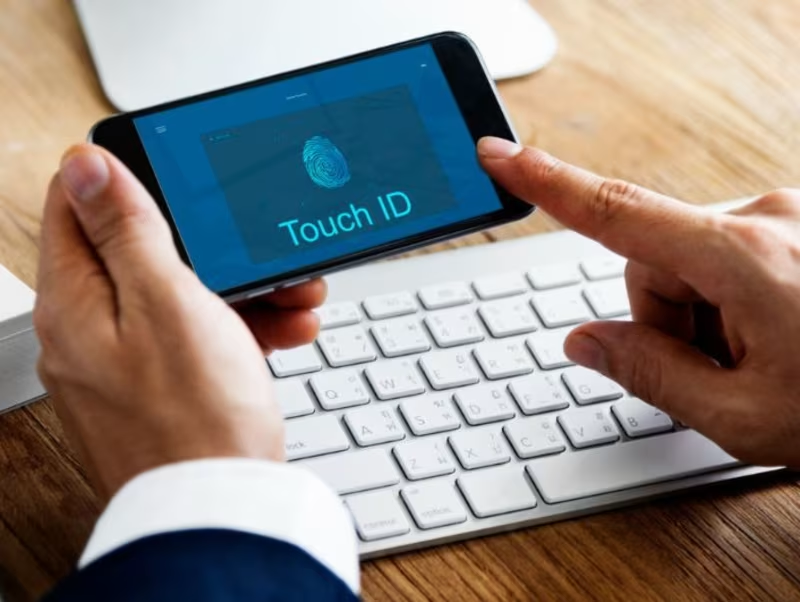
Passwords have been the backbone of digital security for decades, and the root cause of most breaches.
Stolen credentials still power phishing attacks, ransomware campaigns, and account takeovers. Even with traditional MFA in place, attackers exploit human behavior through prompt bombing and session hijacking.
That’s why Passwordless Authentication is gaining serious attention. But is it truly the future of security, or just industry hype?
Why Passwords Keep Failing
Passwords depend on shared secrets. If a secret is stolen, guessed, or reused, attackers win.
Even traditional MFA can be bypassed through phishing proxies. This is where phishing-resistant authentication becomes critical. Instead of relying on codes or SMS messages, modern systems use cryptographic proof tied to a trusted device.
The problem isn’t users. The problem is the password model itself.
What Makes Passwordless Authentication Different?
Passwordless Authentication eliminates shared secrets entirely. Instead of something you know, it uses something you have (a device) or something you are (biometrics).
Modern FIDO2 authentication, backed by the FIDO Alliance, uses public-key cryptography. The private key never leaves the user’s device. That means there’s nothing reusable for attackers to steal.
Because FIDO2 authentication binds login requests to legitimate domains, it enables true phishing-resistant authentication. Fake login pages simply don’t work.
This makes Passwordless Authentication far more secure than passwords combined with SMS-based MFA.
Why It Aligns with Zero Trust Security
In a Zero Trust security model, identity becomes the new perimeter. Every access request must be strongly verified.
Passwordless Authentication strengthens Zero Trust security by increasing identity assurance while reducing friction for users. It removes credential databases, reduces attack surface, and minimizes helpdesk resets.
Security improves, and user experience improves with it.
Is Passwordless Authentication Just Hype?
Not anymore! Cloud platforms and enterprise systems increasingly support FIDO2 authentication by default. Regulators are also pushing for phishing-resistant authentication methods in high-risk industries.
While legacy systems still have slow adoption, the direction is clear: Passwordless Authentication is moving from innovation to expectation.
Organizations that adopt Passwordless Authentication strategically, starting with privileged accounts, can eliminate one of the most exploited attack vectors in cybersecurity.
Conclusion
Passwordless Authentication is not hype. It’s a structural evolution in identity security.
As phishing grows more sophisticated, only phishing-resistant authentication methods like FIDO2 authentication can close the gap.
In a world built on Zero Trust security, removing passwords isn’t optional — it’s inevitable.
Recommended articles


What Is Microsoft Entra ID? A Simple Guide to Passwordless Strategies
Take Your Identity Strategy
to the Next Level
Strengthen your organization's digital identity for a secure and worry-free tomorrow. Kickstart the journey with a complimentary consultation to explore personalized solutions.